
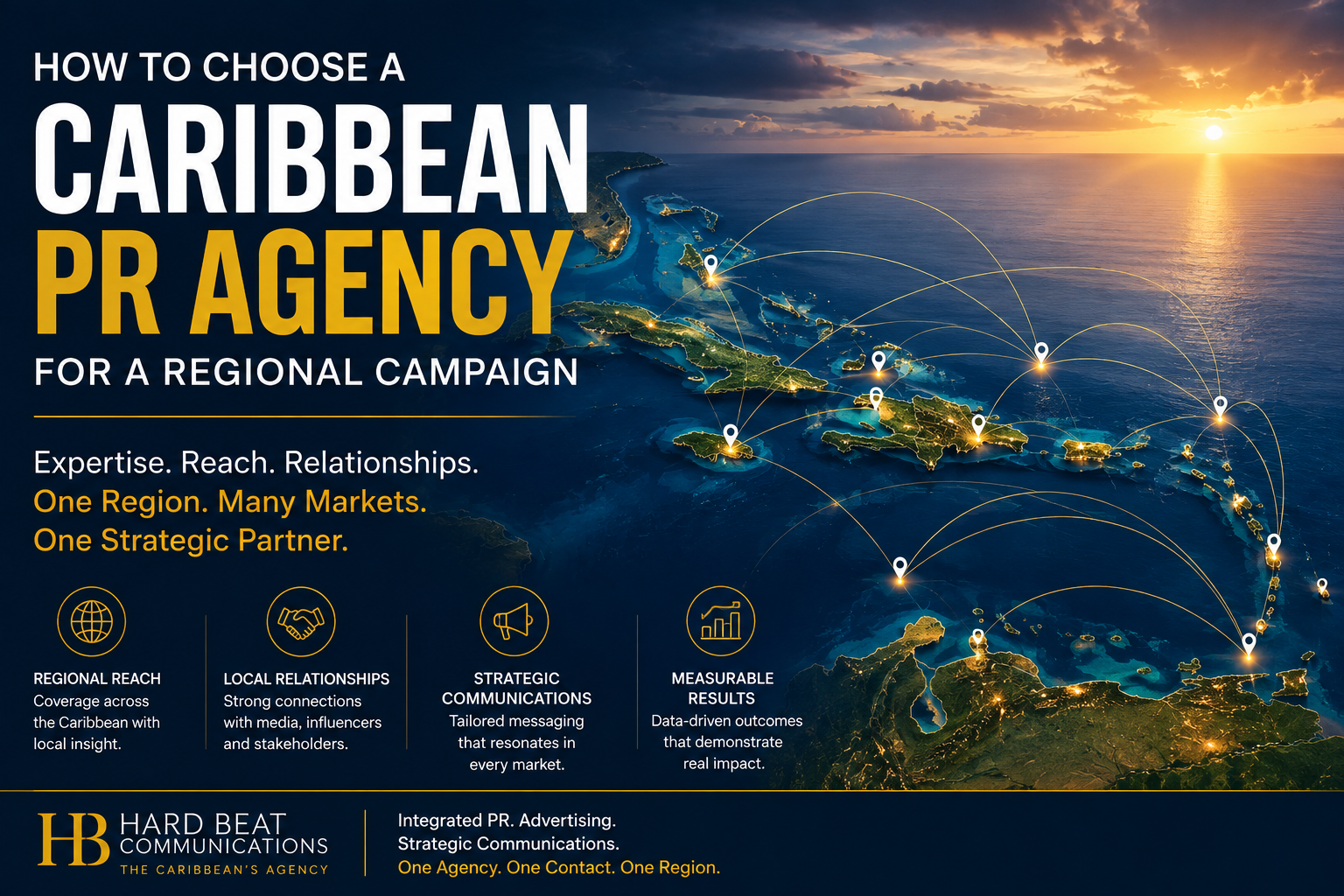
Choosing a public relations agency is never simply about finding someone who can write a press release or secure a media interview. When the campaign spans the Caribbean, the decision becomes considerably more complex.
The Caribbean may be described as one region, but it is made up of distinct countries and territories with different media environments, cultures, languages, political systems and business communities. A campaign that resonates in Jamaica may require a different approach in Guyana. The media strategy for Trinidad and Tobago may not be the strategy needed in Barbados, The Bahamas or the Dominican Republic.
For companies, governments and organizations planning a multi-market Caribbean campaign, the right PR agency therefore needs to provide something beyond traditional public relations. It needs to understand how to coordinate regionally while executing locally.
Here are seven questions organizations should consider when choosing a Caribbean PR agency for a regional campaign.
1. Does The Agency Really Have Regional Reach?
“Caribbean PR” can mean very different things.
An agency may be highly experienced in one country while having limited capabilities elsewhere. That can work perfectly well for a single-market campaign. It becomes more challenging when an organization needs to communicate simultaneously across several Caribbean countries. Before selecting an agency, ask specifically where it can execute.
Does it have established media relationships across the markets you need? Does it work with local partners? Can it coordinate activity in several countries without requiring the client to manage separate agencies?
That distinction matters. Current Caribbean agencies themselves increasingly emphasize the differences among individual markets. Fusion IMC, for example, describes the Caribbean as “not one market” and highlights the need to account for different politics, media environments, cultures and consumer trust signals. For a regional campaign, geographic reach should therefore be demonstrated through actual capability - not simply the word “Caribbean” on an agency website.
2. Can It Localize A Regional Message?
Regional consistency is important, particularly for multinational companies but consistency should not mean sending exactly the same message everywhere.
A strong Caribbean PR agency should be able to take the client's central corporate narrative and determine how it should be positioned within different markets. Consider a company announcing a major regional investment.
In one country, employment may be the strongest story, in another, local procurement or community investment may matter more. Elsewhere, journalists may focus on environmental implications, government agreements, consumer benefits or economic impact.
The underlying facts remain consistent. The storytelling changes according to the audience. That ability to understand local context is increasingly central to how Caribbean communications agencies position their work. Accela Marketing, for example, emphasizes cultural and market intelligence as part of developing communications for Caribbean audiences. The agency you choose should therefore understand not only what your organization wants to say, but also what each market needs to hear.
3. Does It Have Genuine Media Relationships?
A media database is useful but it is not the same thing as media relations. Effective PR depends on understanding journalists, editors, producers and publications: what they cover, what interests their audiences and what constitutes a credible story.
For regional campaigns, that knowledge must extend across multiple media ecosystems. Ask prospective agencies how they approach media outreach.
Do they simply distribute press releases?
Do they conduct targeted pitching?
Can they identify relevant business, consumer, trade, broadcast and digital media within individual markets?
Can they coordinate interviews and respond when journalists need additional information?
And importantly, how do they determine which story belongs with which outlet?
The objective should not simply be to produce a long media list. It should be to put the right story in front of the right journalist in the right market.
4. Can One Agency Actually Coordinate The Campaign?
This is one of the biggest practical considerations for companies operating across the Caribbean. Imagine running a campaign across six markets using six independent agencies.
The client may suddenly find itself managing six account teams, six sets of deadlines, six reports, multiple invoices and potentially six interpretations of the same communications strategy.
For some campaigns, individual local agencies may be appropriate but for larger regional campaigns, however, organizations should consider whether one lead agency can coordinate the strategy and local execution.
Hard Beat Communications, for example, structures its regional offering around a single strategic partner coordinating campaigns across Caribbean markets through its partner network.
Whatever agency model a company chooses, it should ask:
Who owns the regional strategy?
Who coordinates local execution?
Who ensures message consistency?
Who manages reporting?
And who is ultimately accountable for results?
The simpler those answers are, the easier the campaign is likely to be for the client to manage.
5. Can It Connect Caribbean Visibility With Global Communications?
Many Caribbean campaigns are not exclusively Caribbean campaigns. A multinational entering Guyana may need Guyanese media coverage while simultaneously communicating with international investors. A tourism organization may need Caribbean visibility alongside North American and European coverage. An energy company may need local stakeholder communications, regional media relations and international trade or financial press.
The agency should therefore understand how regional communications fit within the company's larger global strategy. That may include targeted media relations, international press release distribution, executive visibility, investor communications or coordination with an organization's global communications team.
The goal is not to choose between local and global. The strongest campaigns connect the two.
6. What Evidence Can The Agency Show?
Awards and client logos can establish credibility, but results tell you what an agency actually delivered. Before selecting a Caribbean PR partner, examine its case studies and ask what happened after the strategy was implemented.
Depending on the campaign, useful evidence might include:
earned media placements;
interviews secured;
audience reach and impressions;
campaign engagement;
press release distribution;
stakeholder participation;
market coverage;
digital performance;
or other measurable communications outcomes.
Different campaigns require different measurements, so no universal PR metric determines success. But there should be evidence. A prospective agency should also be willing to explain what the numbers mean, rather than presenting impressive-looking figures without context.
7. Does The Agency Understand Your Sector?
Regional knowledge alone may not be enough. A tourism campaign requires a different communications approach from an offshore energy project. A government public-awareness initiative is different from launching a consumer brand. A BPO expansion, investment promotion campaign or financial-services announcement brings its own stakeholders and reputational considerations. Look for an agency that understands - or can demonstrate the ability to quickly understand - your industry's media landscape, regulatory sensitivities, stakeholders, terminology, and potential risks.
This becomes particularly important in highly scrutinized sectors such as energy, mining, healthcare, financial services, infrastructure and government. The agency doesn't necessarily need to have represented an identical company. But it should understand how to communicate complex issues credibly.
The Question Is Bigger Than “Who Can Get Us Coverage?”
Media coverage matters, but for a regional Caribbean campaign, the more important question is: who can help us communicate effectively across several different markets while maintaining one coherent strategy?
That requires a combination of regional knowledge, local relationships, strong storytelling, operational coordination, and measurable execution. It also requires recognizing something fundamental about doing business in the Caribbean: regional reach does not eliminate local nuance. The right Caribbean PR agency should be able to provide both.
One Region. One Strategy. Local Execution.
Hard Beat Communications provides integrated public relations, advertising, and strategic communications across Caribbean markets through one regional agency. Since 2004, Hard Beat has supported corporations, governments, tourism organizations, nonprofits and international brands with Caribbean media relations, market-entry communications, content, stakeholder engagement, advertising and global media distribution.
Through an active Caribbean and Latin American partner network and global distribution capabilities through Cision/PR Newswire, campaigns can be coordinated across multiple markets while maintaining one strategy, one point of contact, and consolidated execution.
Planning a regional Caribbean campaign? Talk to Hard Beat Communications about building a communications strategy tailored to the markets you need to reach.