
Caribbean Market Entry: A Communications Guide for Global Companies
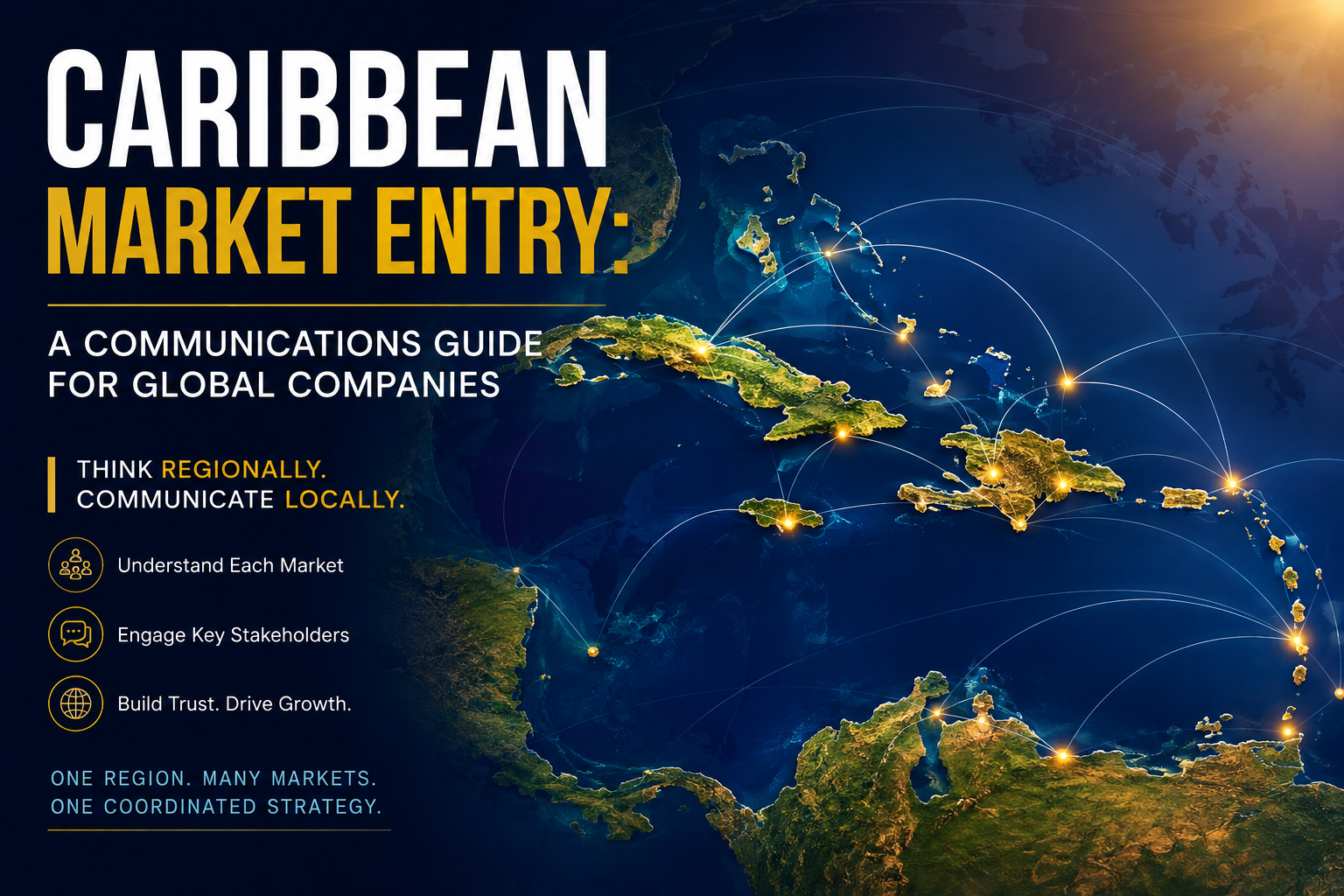
For global companies looking toward the Caribbean, the region can be deceptively simple on a map. A cluster of relatively small markets, many sharing historical, economic and cultural ties, can appear to offer a single regional opportunity. But companies that approach the Caribbean as one homogeneous market often discover quickly that successful market entry requires something much more nuanced.
Jamaica is not Guyana. Trinidad and Tobago is not Barbados. The Bahamas is not the Dominican Republic. Belize differs from Saint Lucia, just as Suriname differs from Antigua and Barbuda. Each market has its own media ecosystem, political environment, business culture, community expectations and stakeholder relationships. That makes communications not something to add after market entry, but part of the market-entry strategy itself.
The Caribbean Offers Regional Opportunity - But Local Markets Still Matter
Economic integration continues to create opportunities for companies looking at the Caribbean as a regional market. In 2026, the World Bank noted that greater regional cooperation can help Caribbean countries “expand their effective market size and pool scarce resources,” while also reducing transaction costs and improving coordination. CARICOM and the Caribbean Single Market and Economy have also created important frameworks for deeper regional trade and integration. But economic integration does not erase national differences.
A company may develop one overarching Caribbean business strategy while still needing different communications approaches in Guyana, Jamaica, Trinidad and Tobago or Barbados.
Regulations differ; Media priorities differ; Government structures differ; Consumer expectations differ. Even the way business relationships are developed can vary considerably from market to market.
The lesson for global companies is straightforward: think regionally. Communicate locally.
1. Start Communications Before You Enter The Market
One of the most common mistakes companies make is treating communications as something that begins when the new office opens, the investment is announced or the product launches. By then, important perceptions may already be forming.
Before entering a Caribbean market, companies should understand:
Who are the important government and regulatory stakeholders?
Which media outlets shape business and public opinion?
What community concerns surround the industry?
Who are the credible local partners and organizations?
What issues could create reputational risk?
How should the company's global story be adapted for the local market?
Communications planning during the market-entry phase allows a company to introduce itself intentionally rather than allowing others to define it first. For companies entering industries such as energy, infrastructure, financial services, healthcare, telecommunications or business-process outsourcing, that groundwork can be particularly important.
2. Relationships Matter
The Caribbean remains highly relationship-driven. The U.S. International Trade Administration's guidance on Jamaica notes that much trade between Jamaica and the United States results from longstanding business relationships. Its market-entry guidance also emphasizes the value of establishing relationships with prospective local partners.
Its 2026 guidance for Guyana similarly advises U.S. businesspeople to take time developing close relationships with local representatives and business partners. Those principles extend beyond sales.
Relationships matter in communications too. Knowing the media landscape, understanding how government institutions communicate, recognizing respected community voices and knowing when an issue requires local context can make the difference between a message that lands and one that creates unnecessary friction. A press release sent from headquarters cannot replace local intelligence.
3. Do Not Copy And Paste Your Global Messaging
Global companies understandably want brand consistency but consistency does not require identical messaging everywhere. A corporate announcement written for investors in New York or London may need a different emphasis when presented in Georgetown, Kingston or Port of Spain. Consider a multinational announcing a new Caribbean operation.
International financial media may care about investment size, revenue expectations and strategic growth.
Local media may care more about:
employment,
local procurement,
community benefits,
environmental impact,
training,
government agreements,
or how the investment affects ordinary citizens.
The facts remain the same but the communications context changes. Effective Caribbean communications translate a global corporate narrative into messages that are relevant to the people actually living in the market.
4. Build Stakeholder Communications Alongside Media Relations
Market-entry communications should extend beyond securing press coverage. Companies may need to communicate with:
national and local government,
regulators,
business associations,
employees,
communities,
suppliers,
investors,
industry organizations,
and civil society.
This is especially important in sectors where operations directly affect communities or public resources. Energy, mining, infrastructure and large-scale development projects, for example, may generate questions about employment, environmental responsibility, local participation and economic benefits long before a crisis occurs. A strong communications strategy identifies those audiences early and creates clear, consistent channels for engagement.
5. Understand That Regional Media Relations Are Not One Media List
There is no single “Caribbean media list” that substitutes for genuine regional media relations. Major Jamaican outlets serve different audiences from publications in Guyana. Trinidad and Tobago has its own influential media environment. Barbados, The Bahamas, the Eastern Caribbean, the Dominican Republic, Haiti, Suriname and the Dutch and French Caribbean each add their own languages, cultures, institutions and media structures.
For a multi-market campaign, companies need both coordination and localization. That can mean one regional strategy with different:
media targets,
spokespeople,
angles,
timing,
stakeholder outreach,
and supporting content for each priority country.
The objective is not to create twenty completely separate campaigns. It is to build one coordinated strategy capable of adapting intelligently across markets.
6. Prepare For Reputation Risk Before A Crisis
Companies entering new markets should also establish their communications infrastructure before something goes wrong. A crisis is not the ideal time to begin identifying local media, searching for trusted communications partners or learning how public opinion operates in a country.
Before launch or expansion, companies should know:
who leads communications locally and globally,
who has authority to respond,
which stakeholders need immediate notification,
how local and international messaging will be coordinated,
and how misinformation will be addressed.
Regional crisis preparedness is particularly important because an issue beginning in one Caribbean country can quickly travel across digital media, regional news platforms and international networks. Reputation today moves faster than geography.
7. Use Global Distribution - But Pair It With Regional Execution
Global press release distribution remains valuable, particularly for publicly traded companies, major investments, partnerships and corporate milestones. But global distribution and Caribbean media relations perform different functions.
A global distribution network can provide scale, but local and regional media relations provide context, relationships and targeted engagement. The most effective approach often combines both. A company announcing a major Caribbean investment, for example, may distribute its news internationally while simultaneously conducting targeted outreach to business media, national publications and stakeholders in the specific Caribbean markets affected. That is how companies connect local relevance with global visibility.
One Region. Many Markets. One Coordinated Strategy.
The Caribbean offers compelling opportunities for global companies. Regional integration can create scale. Growing markets such as Guyana are attracting new investment. Jamaica continues to draw international companies in sectors ranging from tourism and technology to BPO and logistics. Energy, infrastructure, telecommunications, finance and digital services continue to reshape economies throughout the region. But successful market entry requires more than identifying an opportunity.
Companies must earn understanding, visibility, and trust, and that process begins with communications. The strongest Caribbean market-entry strategies recognize a simple reality: the Caribbean can be approached as a region - but it must be understood market by market. For global companies, that means combining local relationships, regional coordination and international communications capacity from the beginning.
Entering The Caribbean?
Hard Beat Communications provides Caribbean market-entry communications, media relations, stakeholder engagement, strategic content, crisis communications and global distribution through one regional agency. With an active communications partner network across Caribbean markets and global distribution capabilities through Cision/PR Newswire, Hard Beat helps international companies communicate locally, regionally and globally through one point of contact.