
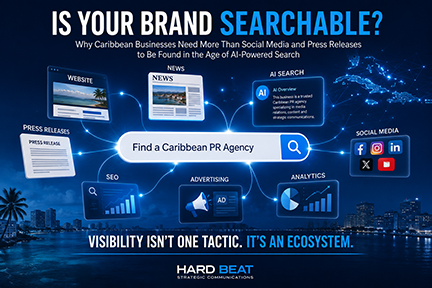
Social media posts are not SEO. Sending out press releases without guaranteed publication is not SEO either. Caribbean brands need an integrated visibility strategy that helps people - and increasingly AI platforms - find, understand and trust them.
Caribbean companies are creating more content than ever. They are posting on Instagram, Facebook and LinkedIn. They are sending press releases. They are running digital ads, publishing promotional graphics and asking audiences to follow, like and share. Yet many remain surprisingly difficult to find online.
A company may post several times each week and still fail to appear when a potential customer searches for its services. It may distribute a press release and receive no meaningful search benefit because the release was never independently published, linked to or indexed as authoritative content.
That is because activity is not the same as discoverability. Posting more does not automatically make a brand more searchable.
Search engine optimization, public relations, social media and advertising can support one another - but they are not interchangeable.
What SEO Actually Does
Google defines search engine optimization as helping search engines understand content while helping users find a website and decide whether to visit it. Its official guidance emphasizes crawlable websites, useful content, clear page structure and information that search systems can understand.
A genuine SEO strategy may include:
keyword and search-intent research;
properly structured page titles and headings;
optimized metadata;
clear website architecture;
internal linking;
useful, original content;
mobile performance and technical accessibility;
structured data where appropriate;
credible backlinks and third-party citations;
local and regional search optimization;
and regular measurement through search analytics.
SEO is therefore not one post, one press release or one technical adjustment. It is the sustained process of making a brand’s digital presence easier to discover, understand and trust. Google also stresses that SEO should support helpful, reliable, people-first content - not content created merely to manipulate rankings.
Social Media Is Valuable-but It Is Not SEO
Social media can help a brand:
remain visible to existing followers;
distribute news and ideas;
build community;
drive traffic;
demonstrate personality;
and engage directly with customers.
But a social-media post usually has a short lifespan. Its visibility depends heavily on the platform’s algorithm, the size and quality of the audience, and whether people interact with it. Posting every day does not necessarily create a strong, searchable body of information about the company.
A business may have hundreds of social posts but still lack:
a clear services page;
an optimized company description;
authoritative articles;
searchable case studies;
location-specific landing pages;
consistent executive biographies;
or answers to the questions customers are actually typing into search engines.
Social media can amplify an SEO strategy. It cannot replace one.
Sending a Press Release With No Guarantees Of Pick Up Is Not SEO
A press release is an important communications tool when a company has genuine news. It can announce a launch, expansion, partnership, appointment, funding round, award, event or major corporate development. But distributing a release does not guarantee that journalists will cover it. It also does not guarantee that the release will produce authoritative backlinks, sustained rankings or meaningful search visibility.
The SEO value depends on what happens next:
Was the release published on credible platforms?
Did journalists or industry outlets independently report the story?
Did those stories link to the company?
Did the release point audiences toward a well-structured, relevant page?
Did it create lasting third-party validation?
Without those outcomes, press-release distribution remains distribution—not a complete SEO strategy.
That does not make press releases unimportant. It means they must be used as part of a wider visibility system.
Earned Media Is Increasingly Important to AI Visibility
This distinction matters even more as people begin using AI-generated answers alongside - or instead of - traditional search results. Google continues to expand AI Overviews, AI Mode and conversational search experiences that allow users to ask longer questions, receive synthesized answers and continue with follow-up questions.
People are no longer searching only with short phrases such as:
“Caribbean PR agency.”
They may now ask:
“Which communications agency has experience managing campaigns across multiple Caribbean markets?”
“What are the most credible financial-technology companies in the Caribbean?”
“Which Caribbean advertising agency understands regional media, diaspora audiences and international positioning?”
AI platforms then assemble answers from information available across the web. Research published by Muck Rack in May 2026 analyzed more than 25 million links appearing in answers from ChatGPT, Claude and Gemini. It found that approximately 84% of cited links came from earned-media sources, while journalism accounted for about 27% of all citations. Paid and advertorial content represented only a very small share.
That does not mean every press mention guarantees inclusion in an AI answer. It does show that credible third-party information is becoming an important part of how AI systems understand and describe brands.
Caribbean Brands Face an Additional Visibility Challenge
Many Caribbean companies operate across small or fragmented markets. A business may be highly respected in one country but have little searchable information available to someone in another island, the wider diaspora or an international market.
Common problems include:
outdated websites;
vague company descriptions;
inconsistent branding across platforms;
missing or poorly written service pages;
minimal executive information;
limited authoritative coverage;
broken links;
no internal content structure;
and social accounts carrying information that never appears on the company’s owned website.
As a result, potential customers may struggle to understand what the company does, where it operates, who it serves and why it should be trusted. AI systems face the same challenge. When information is fragmented or inconsistent, the brand becomes harder to interpret and less likely to appear confidently in search or AI-generated recommendations.
PR, SEO, Advertising and Social Media Have Different Jobs
A modern visibility strategy should not force one channel to do everything.
SEO builds discoverability
It helps search engines and users find and understand the brand’s owned content.
Public relations builds credibility
It earns independent attention, strengthens reputation and creates third-party validation.
Social media builds engagement
It keeps the brand active, distributes content and creates direct interaction with audiences.
Advertising buys targeted reach
It places a message before defined audiences based on location, interests, behavior or intent. Each channel has value. The problem begins when companies are sold isolated social posts as a complete “digital strategy,” or when press-release distribution is presented as though publication and search authority are guaranteed.
They are not. Visibility requires a system - not a pile of disconnected activities.
What an Integrated Searchable-Brand Strategy Looks Like
A strong regional strategy begins with the company’s owned infrastructure.
The website must clearly explain:
who the company is;
what it offers;
who it serves;
where it operates;
what makes it credible;
and what the visitor should do next.
That foundation should then be supported by:
search-focused articles answering real customer questions;
optimized service and location pages;
consistent company information across platforms;
credible news coverage;
strategic press-release distribution;
case studies and proof of results;
targeted digital advertising;
social content that directs audiences toward owned assets;
and ongoing monitoring of search, media and AI visibility.
The channels should reinforce one another. A press release may generate coverage. The coverage may create authority and referral traffic. A strong website helps convert that traffic.
An optimized article may continue attracting visitors long after a social post disappears. Advertising can introduce the brand to new audiences. Social media can keep the resulting conversation active. That is integrated visibility.
Is Your Brand Visible Where Decisions Are Being Made?
The question is no longer simply whether your business has a website or social-media page.
The question is: can customers, partners, journalists, investors - and AI platforms - find enough credible information to understand and trust your brand?
Hard Beat Communications helps Caribbean and global companies strengthen their visibility through integrated SEO content, strategic communications, earned media, press-release distribution, digital advertising and reputation strategy.
We do not treat social posts, press releases, advertising and SEO as interchangeable services. We build them into a coordinated visibility system designed to help the right audiences find your brand - and understand why it matters.
Ready to Make Your Brand Searchable?
Work with Hard Beat Communications to strengthen your digital foundation, improve your search visibility, and build authority across media, search, advertising, and AI-powered discovery.